Mounting the SSD
The Antec Solo case has internal mounting locations
for four 3.5" disks. In this system, all the disk mounting locations
are filled, so where does the SSD get mounted? Well, as luck would have it,
the SSD is a 2.5" unit, and it's quite thin (7MM). We drilled four holes
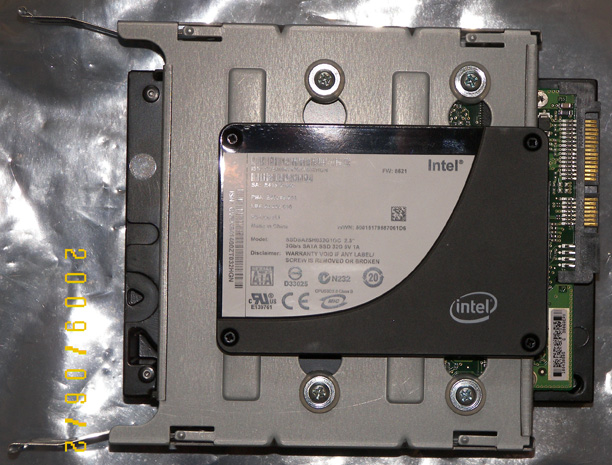
in the bottom of one of the trays, and mounted the SSD under the tray. The
design of the Antec Solo disk bays leaves quite a bit of space between the
bottom of a tray, and the top of the next disk.
Here's a look at the bottom of the disk tray. The SSD fits
in the space just fine.
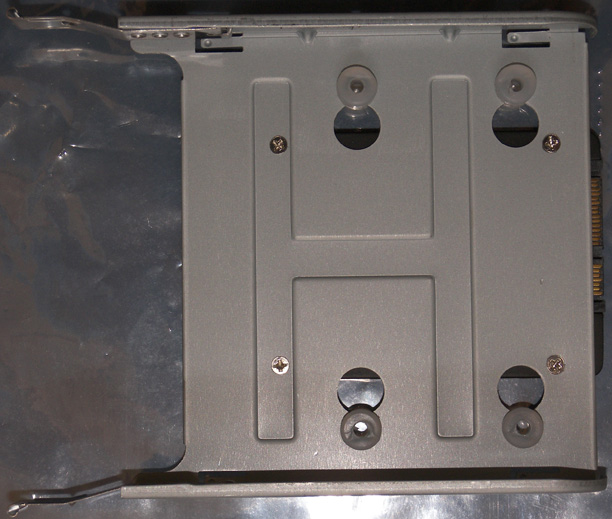
Here's a view from the top, without the 3.5" disk. Again, there's
lots of space around the disk. Positioning of the holes is important. The screws
don't have large heads, so there's not much space to play with.
Alternate Motherboards
In selecting a motherboard to use for this system, we looked
at CPU compatibility, memory compatibility, chipset heatsinks and fan headers.
The functional requirements are that the motherboard
had to be able to accept an Intel LGA-1366 CPU, and the BIOS had to support
ECC. This removes most of the "gamer" motherboards immediately.
There had to be tested and verified ECC memory for the motherboard. This
was necessary to provide a system that would meet the stringent reliability
requirements of an Engineering Workstation.
In order to get an adequate amount of memory into the system,
a motherboard with six DIMM slots is necessary.
In addition, there had to be at least three 4-pin PWM fan headers.
The PWM functionality is one of the key factors in the quiet system. The motherboard
can control the RPM of a PWM fan over a wider range than it can control a 3-pin
(non-PWM) fan. As the fan can reliably spin at a lower RPM, the fan will be
capable of putting out less noise.
The heatsink on the X58 chipset needs to be large (with
no fan), or it needs to be removable. Use of a chipset cooling fan would be
counter to the noise level goals of this system. The airflow past the chipset
heatsink isn't adequate to keep it cool unless the heatsink is very large.
The only motherboards I've found that meet all of these
requirements are the Supermicro
X8STE, the Supermicro
X8ST3-F (adds eight SAS ports to the X8STE), the Supermicro
C7X58 (two 16-lane card slots) and the Supermicro
X8SAX (adds PCI-X slots to the C7X58). Depending on the exact needs of
the user, one of these four motherboards will probably do an excellent job.
None of these motherboards have any overclocking capabilities.
This is appropriate for the type of consumer that these motherboards are designed
for.
|